PEEK Milling
Pockets, holes, mounting faces, thin sections, and irregular profiles. The team reviews tool access and workholding against the drawing.
Engineering plastic machining
Custom PEEK milling and turning from your drawings for instrument, equipment and assembly components. Specify the PEEK grade, geometry, quantity and inspection requirements for a machining review.
Request a PEEK machining quote →The part comes first
Kangsenlong machines PEEK alongside POM, PVDF, PTFE, PPS, PP, and acrylic. We review the material requirement and part geometry together, rather than treating every plastic as interchangeable.
A useful drawing identifies the grade, functional surfaces, mating dimensions, threads, and features that matter in assembly. If the material is not yet selected, tell us about the operating environment so the team can discuss options with you.
Material grade, traceability documents, and any application-specific testing must be agreed before production. A machining capability does not by itself establish medical, food-contact, or other regulatory suitability.
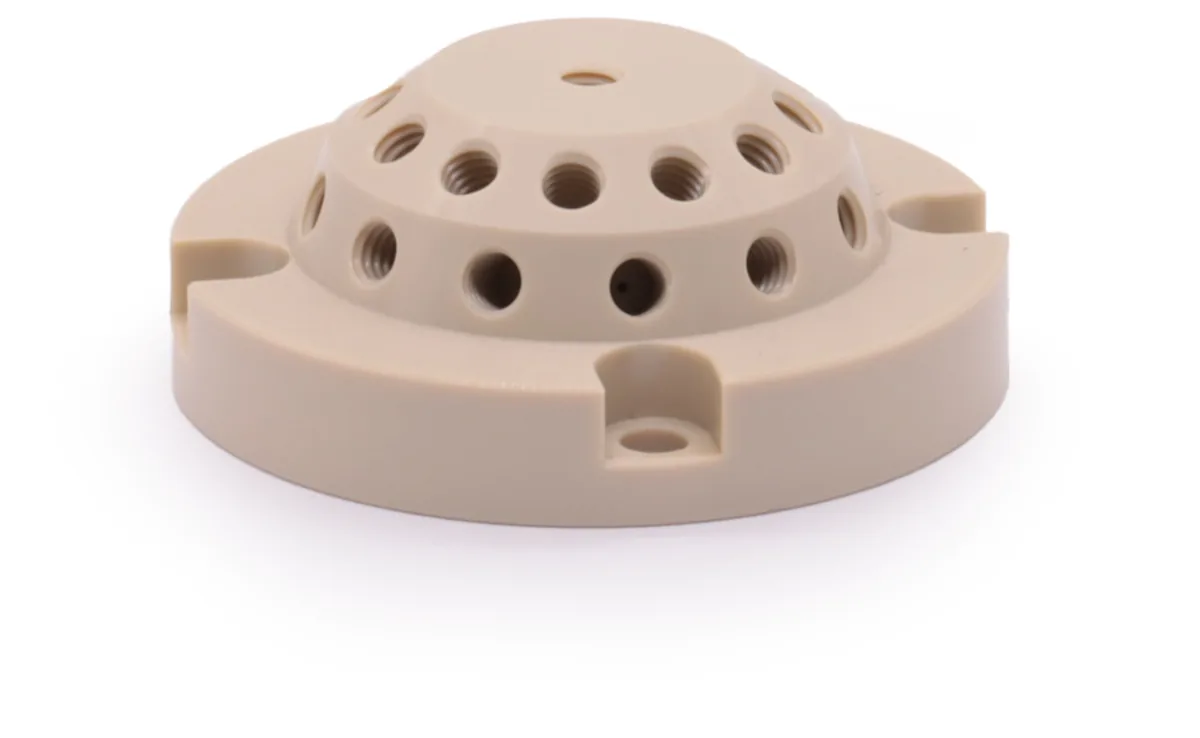
Functional features
Pockets, holes, mounting faces, thin sections, and irregular profiles. The team reviews tool access and workholding against the drawing.
Round parts, sleeves, connectors, and threaded geometry. Specify mating parts and the dimensions controlling the fit.
Define critical dimensions, surface requirements, and inspection records. Measurement methods and acceptance criteria are confirmed for each order.
Send both a dimensioned drawing and a 3D model when available. Include the PEEK grade or approved specification, order quantity, any recurring demand, and the intended function of the component.
We review feasibility, machining route, and inspection scope before providing a project-specific quotation. Tolerances and delivery schedules are not assumed from a generic material page.
Polyetheretherketone (PEEK) and fluoropolymers (PTFE, PVDF) offer exceptional chemical resistance, low outgassing, and mechanical stability for analytical and medical assemblies. However, their crystalline structure and low thermal conductivity make them notoriously prone to internal stress release, dimensional drift, and edge burring during standard CNC operations.
| Material Family | Common Grades Machined | Standard CNC Tolerance | High-Precision Tolerance | Typical Applications |
|---|---|---|---|---|
| PEEK | Natural 450G, GF30 (30% Glass), CA30 (30% Carbon), Bearing Grade | ±0.025 mm | ±0.010 mm | HPLC fittings, rotary valve rotors/stators, medical insulators, IVD structural mounts |
| PTFE / PVDF / PCTFE | Virgin PTFE, Glass-Filled PTFE, Kynar® PVDF, Kel-F® PCTFE | ±0.050 mm | ±0.020 mm | Aggressive reagent valve bodies, diaphragm seats, chemical seals, cryogenic seats |
| PEI (Ultem®) & PPS | Ultem 1000, Ultem 2300, Techtron® PPS | ±0.025 mm | ±0.012 mm | Autoclavable surgical trays, sterilization manifolds, high-voltage analytical insulators |
| PMMA / PC / POM-C | Cast Optical Acrylic, Lexan® PC, Delrin® / Acetal Copolymer | ±0.030 mm | ±0.015 mm | Visual fluidic manifolds, reagent reservoirs, low-friction guide bushings and gears |
Yes. PEEK is among the engineering plastics in our machining scope. Send the drawing, material grade, quantity, and required documentation for review.
Send the approved material grade or specification, including any filler requirements and documentation needs. If it has not been selected, describe the operating environment for discussion. Medical suitability and validation depend on the specific material and application requirements.
Tolerance capability depends on geometry, material specification, and measurement conditions. Mark the critical dimensions on your drawing so the team can assess them before quotation.
Drawing-based quotation
Send a 2D drawing and 3D model, material grade, quantity, critical dimensions, and intended application. Quotation, inspection scope, and delivery schedule are confirmed for your project.